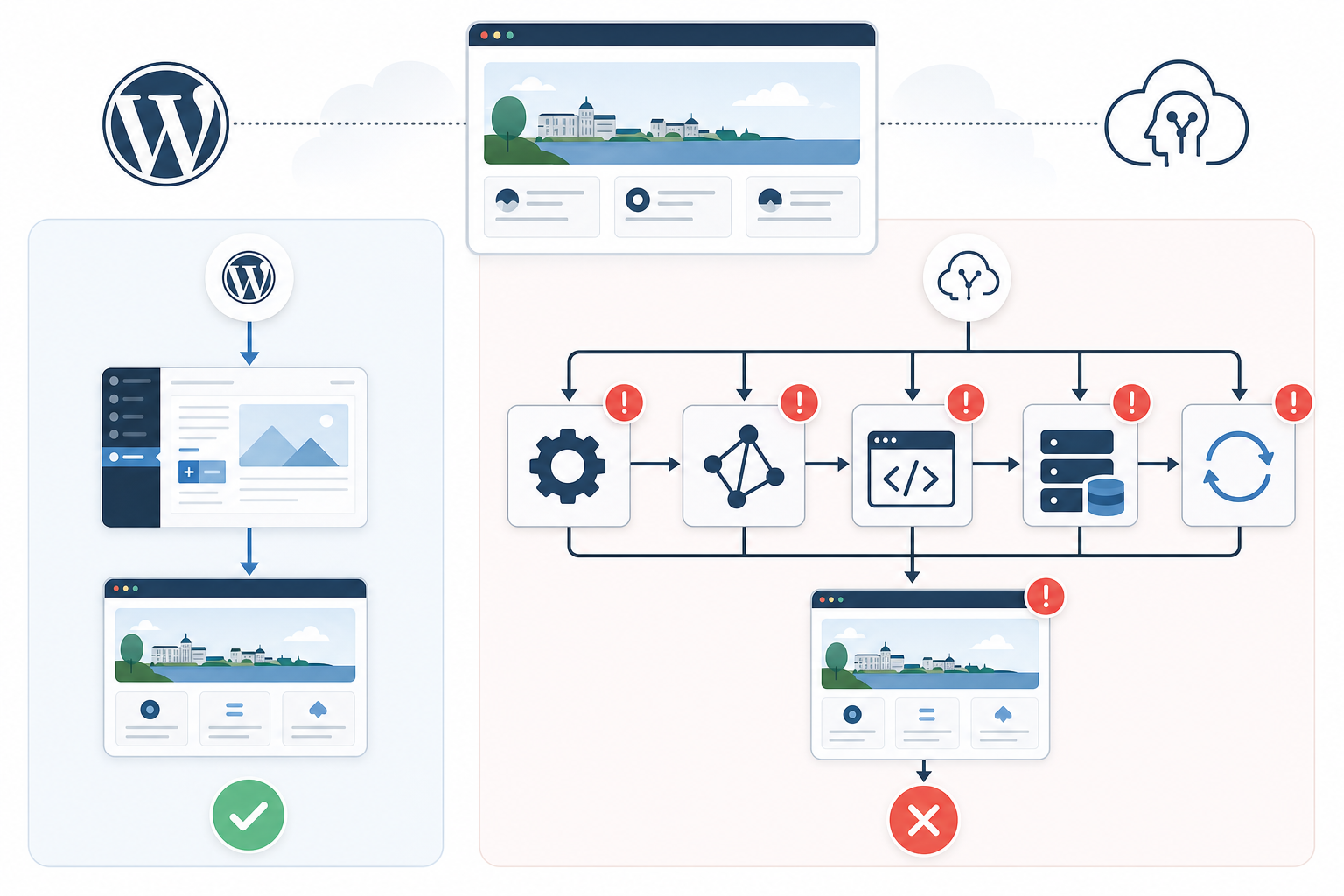
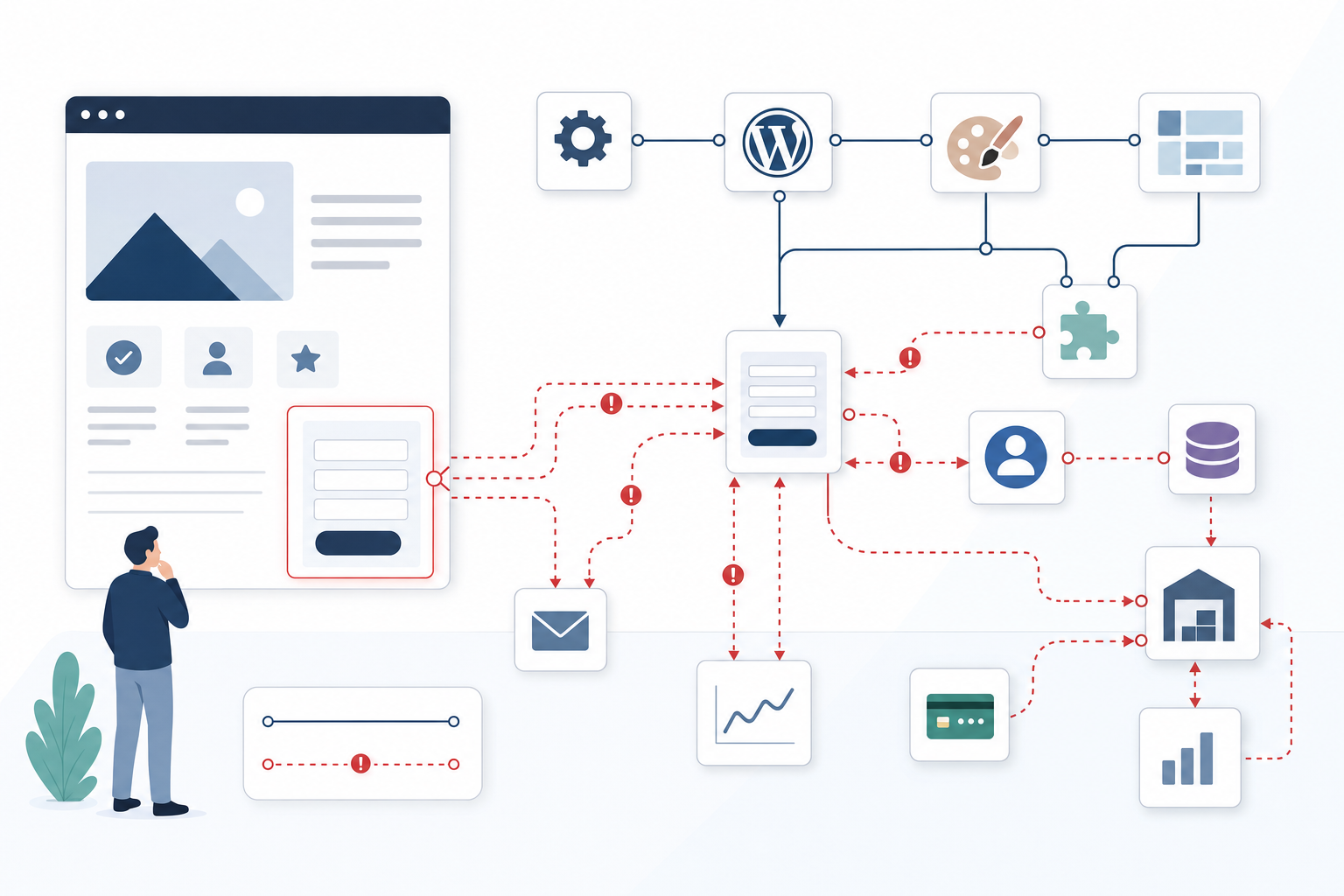
A Norwegian customer who lands on the Swedish page is not just a language issue but a lost business opportunity. This article explains how to audit hreflang, canonical links and country versions before international visibility and conversions are affected.
A Swedish visitor searches for your product, but Google sends her to the English or Norwegian page even though a Swedish version has been published and indexed. When hreflang, canonical and indexing signals point in different directions, you risk paying for content that leads to the wrong market, the wrong form and ultimately fewer relevant business opportunities. The problem is rarely apparent from the page source alone, because a technically correct tag can be undermined by other signals. This article explains how SME owners and marketing managers can identify the problem, prioritise the right URLs and give their web agency a specific troubleshooting brief.

How to identify when Google is showing the wrong language or country version
Language mismatches first become apparent in search data, not in a single Google search from the office. We therefore begin with the Performance report in Google Search Console, filtered by a specific country and then broken down by query and landing page. If Swedish searches lead to addresses under /en/, or if a Swedish URL receives impressions for Norwegian search queries in Norway, you have a clear pair of URLs to investigate. That is more actionable than the general observation that “Google sometimes chooses the wrong page”.
The analysis needs to be performed page by page. A homepage may work correctly while product, category and service pages are connected to the wrong alternatives. Hreflang describes the relationship between corresponding URLs, not between entire websites in general. A working language switcher on the homepage therefore tells you almost nothing about a product page whose translation has been given a new address or was never added to the same language cluster.
Manual searches are useful for illustration, but they provide weak evidence. Results are affected by geographical location, selected interface language, device and previous behaviour, and a private browser window does not remove all these factors. Browser language and location should therefore be treated as troubleshooting signals rather than definitive proof of which version Google should show. You can check the result manually using a controlled language and relevant location, but let Search Console reveal whether the pattern actually recurs in the affected market.
The next step is to use URL Inspection for the addresses that appear to be competing with each other. This shows both the canonical declared by the page and the canonical selected by Google. A canonical is a signal indicating which URL should be treated as the primary version when several addresses are similar. If the Swedish page declares its own address but Google still selects the English page as canonical, the problem is probably deeper than a single hreflang tag.
This is how we would approach it: first, isolate a group of commercially important pages, then compare the Swedish and incorrectly displayed versions as a single connected cluster. The review covers the language and intent of the search queries, the landing address, Google’s selected canonical, indexing status and the links connecting the language versions. This sequence reduces the risk of a developer adjusting tags in the page template while leaving the real cause—such as a redirect or incorrect canonical—in place.
Web analytics completes the picture by revealing visits from unexpected countries to local landing pages. A British product page that mainly receives Swedish organic traffic may warrant investigation, particularly if the page displays a different currency, different delivery terms or a form routed to the wrong sales team. Analytics alone does not prove that Google has selected the wrong language, but it reveals the commercial consequences. You can then prioritise URLs where the wrong language creates genuine friction instead of treating every technical discrepancy as equally urgent.
The hreflang cluster must contain the right URLs and reciprocal references
More hreflang does not automatically mean better hreflang. The common recommendation to connect all language versions only applies when the pages genuinely correspond to one another. A Swedish product page and an English category page do not become relevant alternatives simply because they occupy the same level in the CMS. On the contrary, the false connection can make it harder for Google to understand which page is suitable for the searcher.
A language cluster consists of one page and its actual language or regional alternatives. Each published version should normally reference itself and all other versions using the same set of addresses. If /sv/tjanster/ identifies /en/services/ as the English alternative, the English page should also link back to the Swedish page. If the return reference is missing, Google may disregard that relationship because the connection has not been confirmed in both directions.
A typical HTML reference may be written as <link rel="alternate" hreflang="sv" href="https://example.com/sv/tjanster/">. The self-reference on the Swedish page uses the same Swedish URL, while the other lines point to the final addresses for versions such as Norwegian and British English. According to Google Search Central, alternative versions should reference one another reciprocally, and fully qualified URLs should be used in the implementation.
The language component is normally specified using a language code from ISO 639-1. An optional regional component can be added using an ISO 3166-1 alpha-2 country code, which makes en-GB valid while en-UK is incorrect. Norwegian Bokmål generally uses nb. The region code should not be used as a loose marketing label; it indicates a specific regional audience, while sv is often sufficient for content aimed at Swedish speakers regardless of country.
The most common pitfall we see in this setup is a page template that generates technically well-formed links without understanding the content. An AI-translated title may lead the CMS to assume that a corresponding product page exists, even though the product is not sold in that market or the local address leads to a generic category. It is better to leave an irrelevant version out of the cluster than to invent a corresponding page. Hreflang is a relevance signal, not a requirement for every URL to exist in every language.
x-default serves a different purpose. It can point to a neutral global version or a language and market selector for visitors who do not match the specified alternatives. However, it does not replace clear language versions such as sv, nb or en-GB. If all users are sent to x-default and then automatically redirected, an extra layer is created where both search engines and people may end up in the wrong place.
When troubleshooting hreflang in WordPress, it is therefore not enough to confirm that a multilingual plugin is active. The web agency needs to review how the plugin maps posts, products, taxonomies and custom content types. WooCommerce products may, for example, have different translation relationships from editorial pages, and old slugs may remain in the plugin’s data even when the visible language switcher looks correct. Automation only saves work when the underlying mapping is accurate.

Canonical tags, redirects and indexing can override correct hreflang
A perfectly formatted hreflang tag can be ineffective when the destination page is not eligible to appear in search results. Google uses hreflang to choose between alternative URLs, but the tag cannot make a blocked, redirected or non-canonical page indexable. Canonical and indexing status should therefore be reviewed before making detailed adjustments to language codes. Otherwise, the web agency risks polishing the weakest signal while the stronger conflict remains.
Canonical conflicts are particularly common on multilingual websites built from a shared template. If /sv/produkt/ has a canonical pointing to /en/product/, the page is effectively stating that the English address is the preferred primary version. At the same time, hreflang is trying to describe the addresses as separate local alternatives. Each unique, indexable language version should therefore normally have a canonical pointing to its own final URL.
The review should cover HTTP status, robots rules, meta robots, the declared canonical and the HTML that is actually rendered. A server may deliver hreflang in the original HTML while a script later overwrites or duplicates the tags. For the business, this means that a page can look correct in the CMS editing interface while still sending conflicting signals to Google. What matters is the version that the search engine can retrieve and interpret.
Hreflang references should point directly to the final, indexable address. A link to an old Swedish slug that redirects to a new one creates unnecessary uncertainty and makes the cluster dependent on the redirect chain working correctly. A reference to a URL that returns an error, is marked noindex or is blocked from search engines is even weaker. The local version may exist for users, but it is not a stable candidate for search results.
Automatic redirects based on IP address or browser language often sound like good service, but they can become an obstacle. A Swedish person in Norway may want to visit the Swedish page, while a Norwegian buyer on an international corporate network may be assigned a location that does not reflect the business. If the same redirect affects search engine crawlers, the alternatives may become harder to access and evaluate. A visible language switcher with standard, crawlable links gives both people and search engines a robust route between versions.
Hreflang can be implemented in HTML, in the HTTP header or in an XML sitemap. Using all methods simultaneously does not make the signal stronger; it mainly increases the number of places where the sets can begin to differ. Choose one primary implementation that the web agency can quality-assure and maintain. If parallel methods are required, the same URLs and language and region codes should appear in all of them.
The page’s visible content also needs to support the technical signal. A Swedish URL whose navigation, title and most of the product text are still in English sends a mixed language message. The same applies to internal links that consistently direct Swedish users to English pages. Hreflang helps Google choose between clear alternatives, but it cannot compensate for a language version that is localised in name only.
Fix, validate and monitor at URL level—not just in the page template
The correction is only complete when the live URLs work as a coherent system. After the code change, the website should be crawled and the results placed in a matrix where each indexable local page is matched with its actual equivalents. The matrix exposes gaps that would otherwise disappear into template code: missing translations, old addresses, redirects and canonical signals pointing to the wrong language. The following table is a simplified, hypothetical example of what the data may look like.
| Content group | sv | nb | en-GB | x-default | Self-reference | Return links | Canonical | Indexable |
|---|---|---|---|---|---|---|---|---|
| Circulation pump X200 | /sv/produkter/cirkulationspump-x200/ | /nb/produkter/sirkulasjonspumpe-x200/ | /en-gb/products/circulation-pump-x200/ | /products/circulation-pump-x200/ | Yes | Yes | Own final URL | Yes |
| Installation service | /sv/tjanster/installation/ | /nb/tjenester/installasjon/ → redirects | /en-gb/services/installation/ | /services/installation/ | Yes | No, the Norwegian reference is outdated | Own URL for sv and en-GB | No for the specified nb URL |
| Filter maintenance guide | /sv/guider/filterunderhall/ | Intentionally omitted | /en-gb/guides/filter-maintenance/ | /guides/filter-maintenance/ | Yes | Yes, between published versions | Own final URL | Yes |
| Spare parts category | /sv/produkter/reservdelar/ | /nb/produkter/reservedeler/ | /en-gb/products/spare-parts/ | /products/spare-parts/ | Yes | Yes | Swedish URL incorrectly points to en-GB | Technically yes, but the signals conflict |
The table shows why simply checking whether the tag “exists” creates a false sense of security. The Norwegian reference for the installation service needs to be updated to the final address, while the guide does not need a Norwegian link at all when no genuine Norwegian equivalent exists. The spare parts category has complete return links but a canonical conflict that may cause Google to select the British page. The problems therefore require different corrections even though they all involve the same technology.
A crawler such as Screaming Frog or Sitebulb can export hreflang references, response codes and return links across the entire website. The tool should be configured to follow final URLs and identify invalid language or country codes, duplicate tags, missing self-references and links to non-indexable addresses. However, the export does not replace a content assessment. A tool can see that two URLs link to each other, but it cannot always determine that one describes a product while the other is a broad category.
The manual review should cover several page types, such as the homepage, categories, products, services and editorial content. CMS platforms often generate metadata differently across templates, particularly when WordPress is combined with e-commerce, custom fields or separate translation workflows. A representative sample reveals whether the problem is systematic or limited to particular content types. Once the pattern is understood, the web agency can correct the generator instead of patching individual pages.
After the correction, Google needs to crawl and reassess the addresses before the search results can change. Monitor the same landing pages and queries in Search Console, and check the most problematic URLs with URL Inspection. Monitoring should focus on where relevant impressions and clicks are going, not merely on whether the tags can now be found in the source code. A technically approved implementation has no commercial value if Swedish searchers still land on a version that creates uncertainty or sends them to the wrong contact channel.
Web analytics should therefore be linked to the technical follow-up. Relevant organic traffic per local landing page, engagement with the page’s core content and completed contact or purchase journeys say more than total traffic volume. If the correct language version begins receiving more relevant traffic but conversions remain weak, the next problem may lie in the localisation, the offer or the form. Hreflang restores the conditions for relevance; the tag does not automatically solve every part of the customer journey.
Prioritise pages with clear commercial importance and documented evidence of traffic from the wrong market. These might include products that generate quote requests, service pages for local sales teams or guides that act as an entry point to a purchase. The same method can then be rolled out across the rest of the site. This directs development time towards cases where the wrong language threatens actual revenue, without allowing minor metadata discrepancies to dictate the entire project.
Ultimately, hreflang is a signal, not a guarantee. Google may still select another version based on the language of the content, canonical signals, internal links and the user’s location or language settings. The goal is therefore not to force a result by adding more tags, but to make all relevant signals consistent. When they point in the same direction, it becomes easier for the search engine to select the version that best matches the query.

When hreflang is correct in the code but the wrong version is still displayed
Language errors are found in search data—not through a single manual Google search
A manual search shows what one person sees under specific circumstances, not how an entire market is treated. Instead, segment Search Console by page, country and query, and look for recurring combinations where language, market and landing address do not align. Then inspect the affected addresses with URL Inspection and compare Google’s selected canonical with the canonical declared by the page. This makes it possible to distinguish an hreflang error from a broader indexing or duplication problem.
Example: If the Swedish URL receives impressions for Norwegian search queries in Norway, the Swedish and Norwegian addresses should be reviewed as a single cluster. Do not compare traffic alone; also follow every hreflang reference, canonical and redirect between the two pages.
A single missing return link can leave the cluster incomplete
Each indexable language or regional version should normally confirm the relationship by referencing itself and the other published versions. An asymmetric cluster occurs when, for example, the English page links to the Swedish and German pages, while the German page lacks the return link or uses a retired Swedish address. Google may then ignore the unconfirmed connection even if the other tags are written correctly. Return links are therefore not merely a matter of cosmetic code quality; they are part of how the relationship between the addresses is verified.
Example: Screaming Frog or Sitebulb can export all references and flag missing return links, invalid language codes and URLs outside the expected cluster. The export should then be checked against the pages’ actual content, because technical symmetry does not prove that the pages are genuine equivalents.
Canonical tags, redirects and noindex can outweigh correct hreflang
Hreflang helps Google choose between local alternatives that can actually be indexed. If the British page has a canonical pointing to the US version, redirects or is marked noindex, it is no longer a stable British candidate. The tag may be syntactically perfect and still lose to the signal that another URL is the primary version. An experienced team therefore always reviews the page’s eligibility before troubleshooting the language references in isolation.
Example: For each affected URL, check the HTTP status, robots directives, declared canonical and Google-selected canonical. Only when the page is directly accessible, indexable and self-canonical can you assess whether the hreflang cluster is operating under reasonable conditions.
Template validation misses errors that only affect certain URLs
A correct template shows how the system is intended to work, not how every published page actually works. Products may be missing translations, category slugs may have changed, and editorial pages may use another plugin or data source. Validation therefore needs to begin with final URLs retrieved from rendered HTML, the HTTP header or an XML sitemap. Only then do old links, duplicate sets and redirecting alternatives become visible.
Example: Export problematic landing pages from Search Console, crawl their entire language clusters and then inspect each affected version in URL Inspection. Testing only the homepage can otherwise conceal errors affecting hundreds of product relationships even though the global page template appears correct.
Questions that reveal why Google is showing the wrong language
Does every language version reference itself and reciprocally reference all corresponding versions?
Each page should normally have a self-referencing hreflang and link to its genuine equivalents in other languages. If the Swedish page points to the English page but the English page does not link back, Google may disregard the unconfirmed relationship. Also check that both pages use the same final addresses; a return link to an old URL is not equivalent to a direct link to the indexable page. The task is to verify the entire cluster, not just the line visible on the Swedish page.
Are we using valid language and country codes that match the target audience?
The language is specified with a language code, while the region is an optional addition, such as sv-SE or en-GB. Reversed or invented codes can prevent Google from interpreting the intended audience. Overly narrow regional codes can also create unnecessary complexity if the content is actually aimed at everyone who reads the language. Start with the language’s real audience and add a region only when the page is genuinely localised for a specific market.
Are the alternative language versions indexable and consistent with their canonical tags?
An hreflang URL that redirects, is blocked, has noindex or uses a canonical pointing to another language sends a weak or conflicting signal. Each unique local version should normally be directly accessible, indexable and have a canonical pointing to its own final address. Check both what the page declares and what Google has actually selected. The difference between the two may explain why an apparently correct Swedish page is still replaced by an English page in the search results.
Are we connecting genuine equivalents, or merely pages that happen to occupy the same URL level?
Hreflang should link pages with the same primary content and purpose, such as Swedish and English versions of the same product page. A product page should not be connected to a homepage, category page or materially different page simply because a direct translation is missing. The contrarian but safer solution is often to omit that reference. A smaller but accurate cluster gives Google clearer information than a complete table filled with false equivalents.
Do the page content and other signals communicate the same language as hreflang?
Google interprets hreflang alongside visible text, page titles, navigation, internal links and URL structure. A Swedish page that largely contains English product descriptions may therefore appear less clearly Swedish, even when the tags are correct. The language switcher should lead directly to the corresponding page through standard links, and internal linking should keep the user within the selected version where relevant. Technical international SEO works best when the code and content describe the same reality.
Start with a limited number of important page groups and follow every hreflang link through to the final, indexable URL. When language, canonical, internal linking and page content all communicate the same thing, Google is better equipped to show the correct version to the right searcher. An experienced team or technical partner will first prioritise the landing pages where the wrong language affects leads and sales, correct the root cause and then monitor the same URL pairs in search data. This makes hreflang a controllable part of the website’s marketing activity instead of just another tag assumed to work because it exists in the code.